


Bioanalytical Method Development & Validation
Every BA/BE conclusion is a number produced by an assay. Our bioanalytical laboratory develops, validates, and runs LC-MS/MS methods to ICH M10 — from routine small molecules to peptides like Semaglutide.
Methods
LC-MS/MS Units
Framework
in Pune
What Is Bioanalytical Method Development and Validation?
Bioanalytical method development and validation is the discipline of building an assay that measures a drug in a biological matrix — usually human plasma — accurately, precisely, and reproducibly, then proving it under a formal validation protocol. Every pharmacokinetic parameter in a BA/BE submission traces back to this work; if the method is weak, no downstream statistics can save the study.
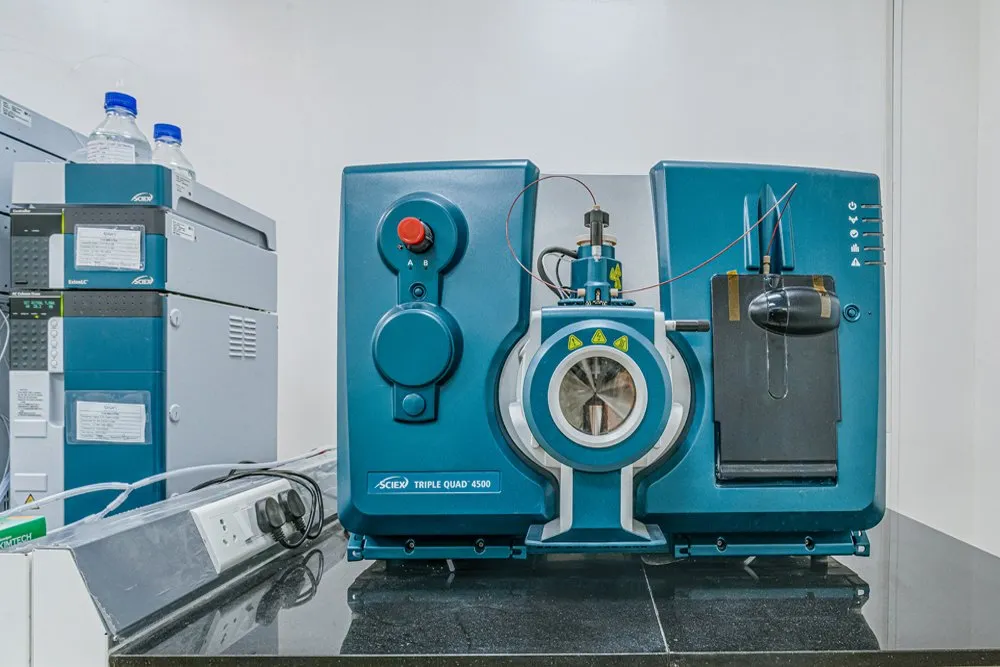
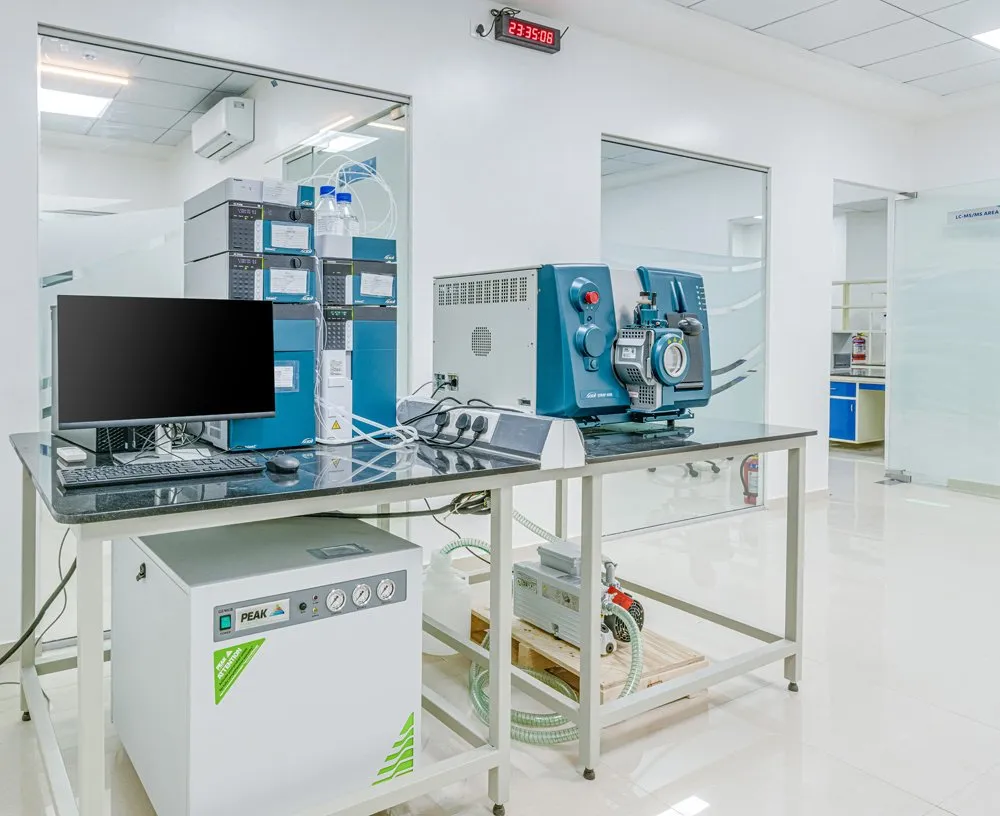
Our laboratory develops and validates methods on coupled triple-quadrupole LC-MS/MS units from AB Sciex, inside our 17,000 sq ft clinical research centre in Pune. The working library stands at 75+ validated methods spanning acids, bases, hormones, and long-half-life molecules — and it extends into large-molecule territory: Semaglutide validated at 1.000 ng/mL in human plasma.
Validation follows ICH M10, the harmonized standard US FDA, EMA, and other agencies now expect — covering selectivity, calibration, accuracy and precision, matrix effect, stability, and dilution integrity — then carries into study sample analysis with incurred sample reanalysis. Sponsors use the laboratory two ways: as the bioanalytical engine of a Celesta-run BA/BE study, or as a standalone method development and validation partner for studies run elsewhere.
Full vs Partial vs Cross Validation
ICH M10 defines three validation scopes — knowing which one a change actually triggers saves weeks.
| Aspect | Full Validation | Partial Validation | Cross Validation |
|---|---|---|---|
| When it applies | A new method, new analyte, or new matrix | Modifications to an already validated method | Two methods or two laboratories generating data within one study or submission |
| Typical trigger | First study for the molecule in that matrix | Anticoagulant change, instrument change, transfer within a lab, LLOQ shift | Method switch mid-program, or multi-site bioanalysis |
| Scope | All parameters — selectivity, calibration, accuracy, precision, matrix effect, stability, and more | From one accuracy-and-precision run up to a near-full validation, justified by the change | Comparison of QCs and incurred samples across the two methods or sites |
What a Full Validation Covers
Selectivity & Specificity
No interfering signal at the analyte or internal standard in blank matrix from multiple sources.
Calibration & Range
A characterized curve from LLOQ to ULOQ that brackets the concentrations the study will produce.
Accuracy & Precision
Within ±15% of nominal — ±20% at the LLOQ — across runs, days, and analysts.
Matrix Effect & Recovery
Ion suppression and extraction efficiency quantified in the real matrix, not assumed.
Stability
Bench-top, freeze-thaw, processed-sample, and long-term storage stability covering study conditions.
Carry-Over & Dilution Integrity
Clean injections after the ULOQ, and proven dilution of above-range study samples.
Peptide-Class Sensitivity, Validated
Method libraries are easy to claim and hard to demonstrate. Ours currently stands at 75+ validated LC-MS/MS methods, and recent work includes Semaglutide validated at 1.000 ng/mL in human plasma — large-molecule quantitation at a sensitivity most laboratories never attempt. If your molecule is difficult, that is the conversation we enjoy.
Where This Work Happens
From Molecule to Reportable Data
- 01
Feasibility & Reference Standards
Molecule chemistry review, internal standard selection, and sourcing of reference standards and matrix.
- 02
Method Development
Extraction, chromatography, and MS/MS transitions optimized until the method is rugged, not merely working.
- 03
Validation to ICH M10
The full parameter set executed under protocol, with a validation report ready for regulatory scrutiny.
- 04
Study Sample Analysis
Batched analysis with calibration and QC acceptance on every run, and incurred sample reanalysis per plan.
- 05
Reporting
A bioanalytical report aligned to the clinical study report — traceable from raw chromatogram to reported concentration.
Why Sponsors Choose Us for Bioanalytical Services
- 75+ validated LC-MS/MS methods, and growing continuously
- Large-molecule capability proven: Semaglutide validated at 1.000 ng/mL in human plasma
- Coupled triple-quadrupole LC-MS/MS units from AB Sciex
- ICH M10-aligned validation designed for US FDA and EMA review
- Standalone lab services or integrated BA/BE study bioanalysis
- Incurred sample reanalysis and full data traceability as standard
Bioanalytical Services: Frequently Asked Questions
1. What is bioanalytical method validation?
2. What parameters does ICH M10 require for validation?
3. What accuracy and precision are acceptable for a bioanalytical method?
4. What is the difference between full, partial, and cross validation?
5. What is incurred sample reanalysis (ISR)?
6. Can LC-MS/MS methods be developed for peptides and large molecules?
7. How long does bioanalytical method development and validation take?
More BA/BE Studies Services
Every study type under one roof. Explore the rest of our ba/be studies capabilities.
Pilot BE Studies
Small, fast studies that measure formulation variability before you commit to a pivotal trial.
Fed & Fasting BE
Food-effect and fed BE studies that show your product performs against the reference in both dosing states.
Patient BE Studies
BE studies in patients when healthy-volunteer dosing is unsafe — cytotoxic, oncology, and high-risk products.
Biosimilar PK Studies
Comparative pharmacokinetic similarity studies for biosimilars, backed by large-molecule LC-MS/MS.
Population BE
Designs and statistics for when average bioequivalence alone cannot answer the prescribability question.
Postmenopausal Studies
Special-population BA/BE studies in postmenopausal women for hormone and women’s-health products.
Transdermal Patch BE
TDS bioequivalence programs covering PK, adhesion, irritation, sensitization, and residual drug analysis.
Nasal Spray BE
Device-based BE combining in vitro performance testing with in vivo PK under a weight-of-evidence approach.
Discuss Your Bioanalytical Services Requirement
Share your molecule and target market, and our scientific team responds with a study design, timeline and detailed proposal within 24 business hours.